Xenith Steel
Xenith Steel
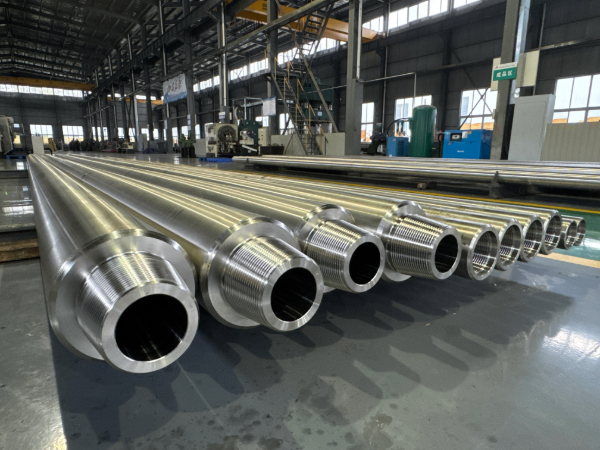
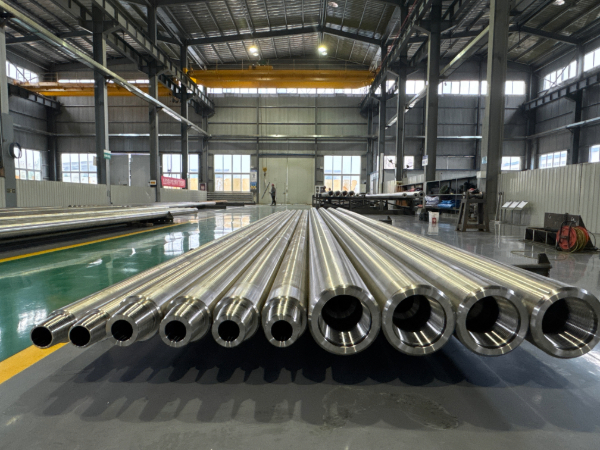
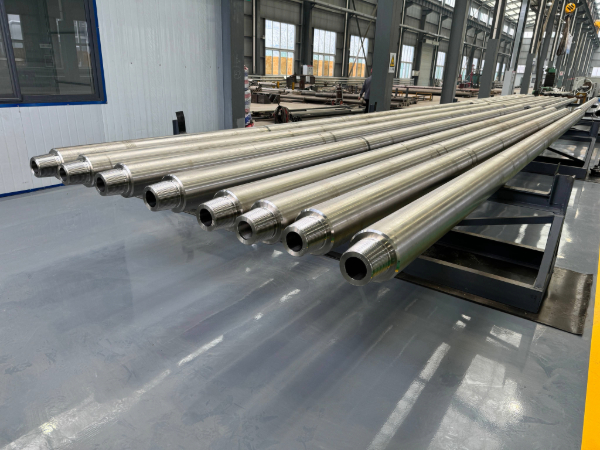
Why does a directional well need spiral-grooved drill collars instead of smooth-bore? The spiral OD reduces wall contact by up to 40% per API 7D, cutting differential sticking risk in high-angle sections. For MWD/LWD interference zones, non-magnetic drill collars (S31600, μ_r ≤ 1.01 per API Spec 7-1 Section 6.3) prevent compass distortion — essential when survey accuracy requires ±0.1° inclination. Xenith Steel's drill collars are full-length quenched & tempered AISI 4145H (285 BHN min per API 7D Table 4, 110,000 psi yield min for OD 3⅛–6⅞ in.), with hardbanding available for abrasive sandstone/shale runs. Every joint undergoes MPI (ASTM E1444) and UT (ASTM E213) — same QC level as drill pipe supplied to CNPC and Schlumberger drilling programs. Between spiral, non-mag, and pony configurations, the right collar selection cuts NPT and keeps wells on trajectory.
API 7D spiral drill collar with NC50 connection
Non-magnetic drill collar for MWD/LWD applications
Pony drill collar short-length section for BHA
Drill collar heat treated AISI 4145H with threaded pin connection

Drill Collars

Product Name:Drill Collars ,Spiral Drill Collar,Non-magnetic Drill Collar,Drill Collar and Drill Stem Accessories;

Size:Outer diameter:3 1/8"-11"

Length:30Ft   /   31Ft   /   43Ft/R1~R3

Connection type:NC , REG , FH, IF

Thread:NC26, NC31, NC38, NC40, NC46, NC50, 5.1/2FH

Material:Stainless Steel/Alloy steel/4145H/Carbon steel

Standard:API 5DP/API Spec 7-1

Application:Oil and gas well drilling/Oilfield Drilling

  • Products details
  • Tolerance table
  • Chemical composition
  • Specification

OCTG Drill Collar Descripiton

Product Name:Drill Collars ,Spiral Drill Collar,Non-magnetic Drill Collar,Drill Collar and Drill Stem Accessories;

Size:Outer diameter:3 1/8"-11"

Length:30Ft   /   31Ft   /   43Ft/R1~R3

Connection type:NC , REG , FH, IF

Thread:NC26, NC31, NC38, NC40, NC46, NC50, 5.1/2FH

Material:Stainless Steel/Alloy steel/4145H/Carbon steel

Standard:API 5DP/API Spec 7-1

Application:Oil and gas well drilling/Oilfield Drilling


Classification
1) Slick Drill Collar
Drill Collar is an integral heavy-wall joint manufactured from a solid bar of modified alloy steel. The solid bar is quenched and tempered to obtain required mechanical properties, then trepanned, drifted and threaded. Drill collar is furnished as slick or spiraled in 30 or 31 foot lengths.
Slick drill collar is supplied with the mill as-rolled surface finish. Spiraled drill collar has grooves machined in its outside surface. The spiral grooves promote even flow of drilling fluid around collar diameter, equalizing pressure and reducing the occurrence of differential sticking.
2) Spiral Drill Collar
Spiral drill collar is used to reduce contact area with hole so as to avoid efficiently bit sticking from differential pressure. Our spiral drill collars are manufactured strictly according to API standard.
a. Materials: AISI 4145H alloy steel, non magnetic steel, etc.
b. Shape: It is a kind of drill collar which adds three dextrogyrate spiral grooves on the outer circle of ordinary drill collar when processing, to reduce the area of contact and friction with well wall, which can effectively prevent pressure sticking.
c. Usage: It is mainly used between drill head and drill pipe, so that it can make drill head work reposefully and keep right trace by providing the pressure and weight for drill head.
d. Standard: API Spec 7-1 or SY/T5144 Standard.
e. Inspection & Test: In the process of production, traceability are maintained from the receipt of raw material to the completion of final products, and serial numbers are die stamped on each work piece body. Inspection and test are performed in every manufacturing process.
3) Non-magnetic Drill Collar
The materials of non-magnetic drill collars are made from chrome manganese low carbon austenitic alloy, which has the following characteristics:
The chemical composition should be controlled strictly in the refining and forging process.
With excellent lower magnetic permeability, high strength of mechanical properties and outstanding resistant to stress corrosion cracking, and no tendency to galling.


Slip and Elevator Recess Dimensions

Drill Collar Diameter (in.)

Elevator Recess Diameter (in.)

Slip Recess Diameter (in.)

Elevator Recess Radius (in.)

4⅛

311/16

4⅜

5

4⅝

6

5⅜

5⅝

5⅞

6

6

3/16

7

3/16

3/16

7

3/16

8

3/16

3/16

9

8⅛

¼

8⅝

9

¼

8⅞

¼

10

9⅛

¼

11

10⅛

10½

¼

  • Process

Drill Collar Production Process

Drill collar manufacturing includes steelmaking, forging, heat treatment, machining, threading, and quality inspection.

  • Tests
  • Packing & Delivery

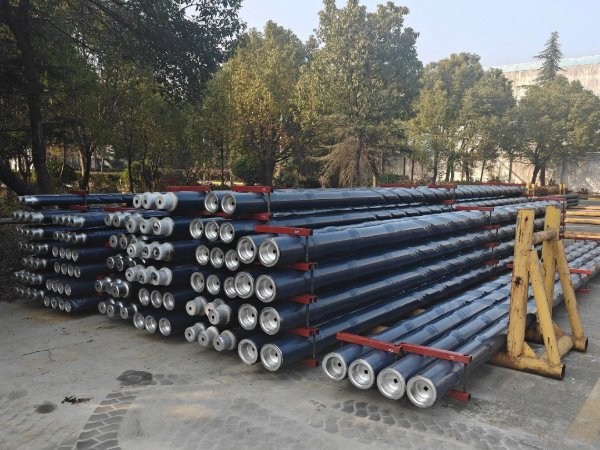
Drill collars are bundled with steel strips, wrapped with waterproof plastic bags, and protected with thread caps. Loading into containers or bulk vessels.

  • Tolerance table

Drill Collar Material Mechanical Properties

Drill Collar Material Mechanical Properties

Drill Collar Diameter (in.)

Minimum Yield Strength (psi)

Minimum Tensile Strength (psi)

Minimum Hardness (BHN)

3⅛ through 6⅞

110,000

140,000

285

7 and above

100,000

135,000

285

  • Chemical composition
  • Inquiry

Frequently Asked Questions

1. 6-3/4" vs 8" drill collar — one size lighter saves how many joints to hit 50,000 lb WOB?

Per API Spec 7-1 Table 3: 6-3/4" DC (2-1/4" ID) weighs 90 lb/ft in air. 8" DC (2-13/16" ID) weighs 138 lb/ft. To deliver 50,000 lb WOB in 12 lb/gal mud (buoyancy factor 0.85): 6-3/4" needs 50,000 / (90 × 0.85) = ~654 ft → 22 joints of 30 ft. 8" needs 50,000 / (138 × 0.85) = ~426 ft → 14 joints. That's 8 joints shorter.

Shorter BHA means less tripping time — at 3 min/stand, that's 24 minutes saved per trip. But 8" requires casing ID > 12" and rig hookload > 600k lb. If those are constraints, 6-3/4" works fine but plan for a longer collar string. Decision rule: if casing and rig capacity allow, run 8" and save the trips. If not, 6-3/4" still delivers the WOB — just give it more length.

2. Non-magnetic drill collar relative permeability — what number keeps MWD readings clean?

API Spec 7-1 §8.6 sets the limit: non-magnetic collars must have relative permeability ≤1.01 per ASTM A342. At 1.01, magnetic interference is under 0.1% of Earth's field at 2 ft spacing — good enough for 0.5° azimuth accuracy. Material choices: S31600 (316 stainless) typically ≤1.005. P550 grade (Cr-Mn-Ni) hits ≤1.003 with yield over 110 ksi.

The hidden problem: cold work raises permeability. A 316 collar machined with aggressive feeds can drift to 1.015+ if the surface layer transforms to martensite. Every collar should be verified with a flux-gate magnetometer per ASTM A342 Method B before it leaves the shop. If permeability exceeds 1.01, your MWD azimuth error jumps to 2-5° — that's the difference between hitting the target zone and drilling right past it.

3. Spiral groove vs slick OD — how much contact area do you actually save?

A spiral drill collar per API Spec 7-1 §7.3 has three helical grooves at 120°, pitch 24-36", depth 0.125-0.188". That leaves about 60% of the OD in contact with the borehole wall versus 100% for a slick collar. A 40% contact reduction drops differential sticking risk significantly — important in depleted zones where overbalance exceeds 2,000 psi.

The trade-off: spiral grooves reduce torsional stiffness by roughly 5-8%. That's minor for WOB delivery but shows up in torque-and-drag modeling. Practical rule: run spiral collars in the first 2-3 joints above the bit in wells over 30° inclination. Run slick collars in vertical sections where sticking risk is low. Don't pay for spiral grooves you don't need.

4. API Spec 7-1 hardness range 285-341 HBW — does NACE sour service drop the ceiling?

API Spec 7-1 Table 5 requires 285-341 HBW for AISI 4145H modified Q&T — that's roughly 30-37 HRC. NACE MR0175 / ISO 15156 §7.3.3 caps carbon steel at 30 HRC for SSC resistance — that converts to 285 HBW. So to satisfy both API and NACE, the collar must land at exactly the bottom of the API window: 285 HBW or lower. Zero margin on the high side.

A 4145H collar heat-treated to 315 HBW (33 HRC) passes API but fails NACE. If sour service is possible, specify the requirement upfront: "85% of API minimum plus NACE MR0175 compliance." The metallurgist needs to select the tempering temperature accordingly — typically a higher temper to keep hardness under 285 HBW without dropping below 275 HBW. Verification: Brinell traverse with three readings, average must be ≤285 HBW for NACE acceptance.

5. NC50 connection on a 6-3/4" DC — what's the max make-up torque before the box swells?

Per API Spec 7-2 Table 5: NC50 make-up torque range is 18,100-25,400 ft-lb for a standard shoulder. On a 6-3/4" DC, the box OD is about 7" — so the wall thickness at the pin shoulder is only (7" − 4.5") / 2 = 1.25". That's thin. At 25,400 ft-lb, the tangential hoop stress at the box ID reaches roughly 65% of yield — safe but watchful.

Pushing to 30,000 ft-lb brings that stress to 85% or higher — now you risk box swell (permanent radial deformation) and connection damage. The box swells, the seal face distorts, and the next make-up will never achieve proper preload. Practical rule: for 6-3/4" DC with NC50, stay in the 22,000-24,000 ft-lb range. Never exceed the API Spec 7-2 value for the connection OD to box OD ratio you're running.

6. Drill collar service life — when do you retire it and when do you just rethread?

API Spec 7-1 §9.1 defines three retirement gates:

(1) OD wear: minimum acceptable OD is 90% of new nominal. A 6-3/4" collar at 6.075" is scrap — it's lost stiffness and WOB efficiency. Below 95%, you start losing enough to measure.

(2) Thread condition: thread height loss over 25% per API RP 7G-2, or any crack visible in the thread root, means rethread or retire. Maximum two rethreads per pin end — each pass removes about 1/8" of length.

(3) Body inspection: full-length UT plus MPI every 2,000 rotating hours or annually, whichever comes first. Cracks over 1/8" in the thread root or stress-relief groove = retire immediately.

In field practice, a well-maintained 4145H collar lasts 5-8 years before OD wear retires it. Thread rework is needed every 2-3 years. If the third rethread removes too much length, the collar is done. Track serial numbers — don't guess, date-stamp the rework.