Xenith Steel
Xenith Steel

When a buried crude pipeline right-of-way crosses a desert zone with soil temperatures reaching 75-95°C at 2m depth, dual-layer FBE (DPS) per CSA Z245.20 Clause 6.2 becomes the only practical coating—its 500-1200µm total DFT at ≤110°C continuous exceeds single-layer FBE's 80°C ceiling (AWWA C213 Table 2) while holding cathodic disbondment ≤5mm at 23°C/28 days (ISO 21809-2 Table 2), verified per NACE TM0186. Xenith Steel applies FBE via electrostatic spray at 200-240°C over Sa 3 white metal blast (ISO 8501-1) with 50-100µm anchor profile, supporting OD 21.3-1620mm for oil/gas and offshore projects from our pipe coating facility in Cangzhou, meeting ADNOC and Saudi Aramco-grade specifications with 25kV DC holiday detection per NACE SP0188.

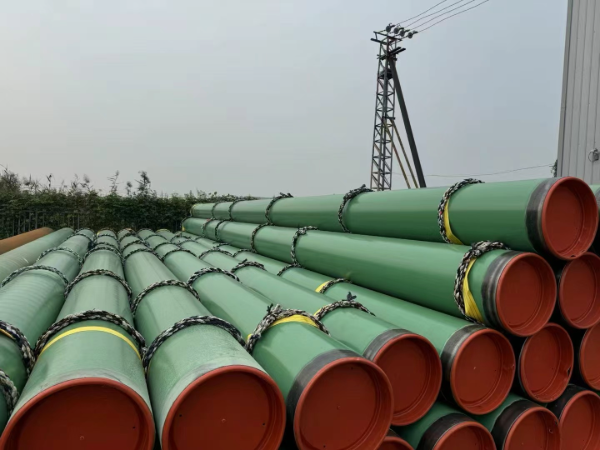
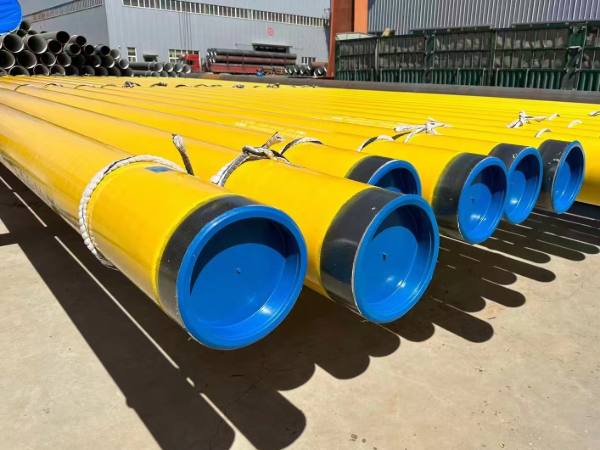
Green FBE coated anticorrosion steel pipe
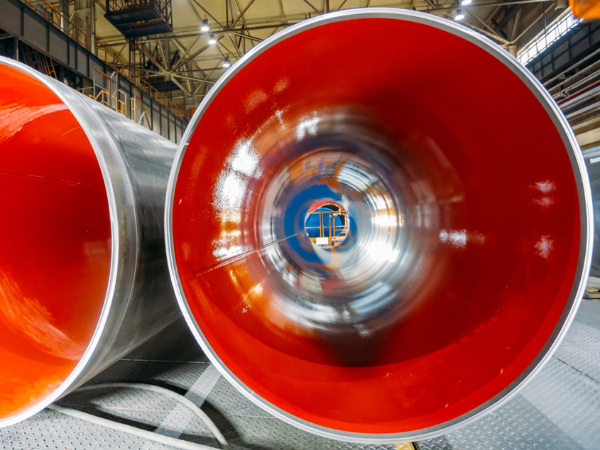
FBE epoxy coating surface finish detail
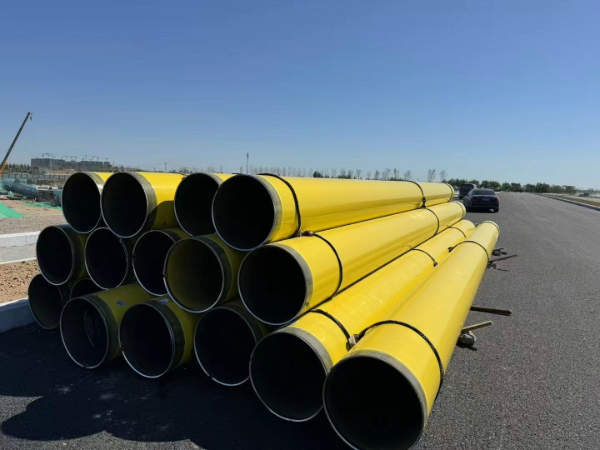
Dual layer DPS FBE coating pipe section
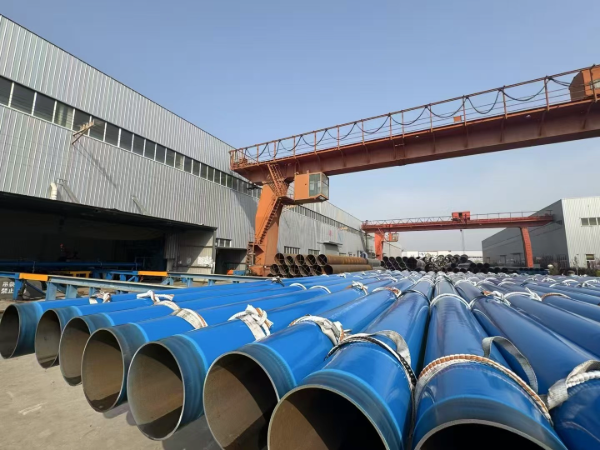
FBE pipe bundles at Xenith Steel coating yard
Spark holiday test on FBE coated pipe

FBE Coating Pipe

  • Products details
  • Tolerance table
  • Chemical composition
  • Specification

FBE Coating Pipe Introduction

Product:

FBE (Fusion Bond Epoxy) Coated Pipe, Epoxy Coated Carbon Steel Pipe

Application:

Used for Coal mine,heat and power plant,oil and gas transmission

Standard:

DIN30670,CAN/CSA-Z245.21

Size:

OD:219-2000MM

Pakcing:

in bundles, in loose, Nylon Strip for each bundle for piece pipe

Color

RAL colors coating powder

Service:

anti-chemical corrosion and water resistance strong


Thickness Of FBE Coating Pipe

minimum 125 µm epoxy layer thickness

minimum 150 µm co-polymer layer thickness

minimum thickness of 1.8 mm to 4.7 mm polyethylene or polypropylene layer

minimum total layer thickness range

M kg/m

Layer thickness in mm

Class A1

Class A2

Class A3

Class B1

Class B2

Class B3

Class C1

Class C2

Class C3

M = 15

1,8

2,1

2,6

1,3

1,8

2,3

1,3

1,7

2,1

15 < M = 50

2,0

2,4

3,0

1,5

2,1

2,7

1,5

1,9

2,4

50 < M = 130

2,4

2,8

3,5

1,8

2,5

3,1

1,8

2,3

2,8

130 < M = 300

2,6

3,2

3,9

2,2

2,8

3,5

2,2

2,5

3,2

300 < M

3,2

3,8

4,7

2,5

3,3

4,2

2,5

3,0

3,8

Please note: The total required thickness may be reduced for SAW pipes by a maximum of 10% on joint seam.
Class 1 and 2 for medium and light applications (sandy soil).
Class 3 – application in extreme conditions (rocky soil) or underwater.


Minimum thickness of finished coating

Pipe Sizes (Specified OD)

Minimum Coating Thickness Chart (mm)

≤ 10 3 /4" (273.1 mm)

2.5

> 12 3 /4" ( 323.9 mm) to ≤ 18" (457 mm)

2.8

> 20" (508.0 mm) to = 30" (762 mm)

3.0

> 32" (813.0 mm)

3.3


Thickness of FBE coating on steel pipes

DN (mm)

Epoxy Powder (µm)

Adhesive Layer (µm)

Min. Thickness on The Coating (mm)

Common Level (G)

Strengthen Level (S)

DN = 100

=120

=170

1.8

2.5

100 < DN =250

2.0

2.7

250 < DN < 500

2.2

2.9

500 =DN < 800

2.5

3.2

DN = 800

3.0

3.7


Features of FBE Coating Pipe

1. FBE coating is corrosion resistant and chemical resistant
2. It has high resistance to cathodic disbondment
3. FBE coating increases the life span of steel pipes providing a constant performance throughout its life span.
4. The FBE coating has high bond strength and bond firmly to mild steel pipe surface.

Uses for FBE Coated Pipe
You will find FBE coated pipe in many applications today. Here are just a few:
  • Oil Pipelines
  • Natural gas industry
  • Refineries
  • Sewage treatment facilities
  • Water treatment applications
  • Electric power plants
  • Food handling industry
  • Process
  • Tests

Properties of a fusion-bonded epoxy (FBE) external pipeline coating can be significantly affected by the conditions under which the FBE powder has been stored. Nova, An Alberta Corporation, and 3M Co. undertook a program of evaluating easily run tests to determine the suitability of FBE powder. These tests are less time consuming than the most commonly used series of tests which involve evaluating laboratory-coated specimens or testing rings taken from production-coated pipe. Detailed here is that study of powder aging, coating application, and laboratory testing of aged powders and the subsequent coatings obtained from these powders. The results indicate that gel-time test was the only powder-test method which was both speedy and accurate.

  • Packing & Delivery
  • Tolerance table
  • Chemical composition

The coating composition of Fusion Bonded Epoxy Steel Pipe comprises: (a) from about 50 wt % to about 90 wt % of at least one epoxy resin; (b) from about 1 wt % to about 30 wt % of at least one catechol novolak-type adhesion promoter; and (c) from about 0.1 wt % to about 5 wt % of magnesium oxide.

Frequently Asked Questions

What is the difference between single-layer FBE and dual-layer FBE / DPS coating per ISO 21809-2?

• Per ISO 21809-2 Table 1 and AWWA C213 Table 1: single-layer FBE applied at 200–240°C, DFT 250–500µm, service temperature ≤80°C continuous for buried pipelines.
• Dual-layer FBE (DPS) per CSA Z245.20 Clause 6.2: inner corrosion layer (epoxy + pigment) + outer mechanical layer reinforced with inorganic fillers, total DFT 500–1200µm, service temperature ≤110°C continuous.
• Impact resistance per ISO 21809-2 Table 4 at −30°C: DPS ≥15 J/mm vs single-layer ≥10 J/mm. Above 5 mm coating → impact energy increases linearly per mm.
• Xenith Steel offers both single-layer (standard buried) and DPS (high-temp/rocky terrain) with full ISO 21809-2 Type 3.1 certification.

What cathodic disbondment performance does FBE achieve per ISO 21809-2 and AWWA C213?

• ISO 21809-2 Table 2: CD radius at 23°C/28 days/−1.5V ≤8 mm (single-layer), ≤5 mm (DPS). AWWA C213 Table 4: CD radius at 23°C/30 days/−1.5V ≤6.4 mm (0.25 in).
• NACE TM0186 Method A (48 h at 23°C/−1.5V): CD ≤10 mm for standard FBE; Xenith Steel targets ≤5 mm for all single-layer runs and ≤3 mm for DPS at 24 h.
• Test frequency per ISO 21809-2 Clause 8.3: one sample per 200 pipes or per production run, whichever is smaller. Rejection threshold: any CD >15 mm per NACE TM0186 Annex A.

How does FBE compare with 3LPE for operating temperature and cathodic protection compatibility?

• Temperature limits per ISO 21809-2 Clause 5.3 and ISO 21809-3 Clause 5.2: FBE single-layer ≤80°C, DPS ≤110°C, 3LPE (PE topcoat) ≤60°C per DIN 30670, 3LPP (PP topcoat) ≤110°C per DIN 30678.
• CP compatibility per NACE SP0169 Section 6.2.3.2: FBE is ion-permeable (10¹–10³ Ω·cm²) allowing CP current to reach steel surface; 3LPE exhibits cathodic shielding at >10&sup5; Ω·cm² per NACE 1C192, reducing CP effectiveness by up to 80% in high-resistivity soil.
• Cost comparison per NACE 10A392: FBE 20–30% lower installed cost than 3LPE for diameters ≤36″. Above 36″, 3LPE side-extrusion becomes more economical.

What surface preparation and application parameters are required per AWWA C213 and NACE RP0288?

• Abrasive blast per AWWA C213 Section 4.2: white metal to Sa 3 (ISO 8501-1), anchor profile 50–100 µm (2–4 mils) per ISO 8503-1, maximum chloride contamination ≤20 mg/m² per ISO 8502-6.
• Preheat per NACE RP0288 Section 4.3: steel surface 200–240°C verified by contact pyrometer at 3 points per pipe. Maximum 4-hour window between blast and coating at <85% RH per NACE RP0288 Section 5.1.
• Electrostatic spray application: gun voltage 60–100 kV, powder feed rate 20–40 kg/h, line speed matched to achieve minimum gel time of 12 s at 230°C per ISO 21809-2 Clause 7.2.
• Minimum DFT after cure: 250 µm per ISO 21809-2 Clause 7.1, measured at 10 points per pipe per ISO 2808. Reject if any point below 200 µm.

What is the maximum and minimum operating temperature for FBE-coated pipelines per applicable standards?

• Continuous service limits: single-layer FBE ≤80°C per AWWA C213 Table 2; DPS ≤110°C per CSA Z245.20 Table 1. Short-term excursions per ISO 21809-2 Clause 5.4.2: DPS ≤120°C for ≤100 h cumulative, single-layer ≤95°C for ≤50 h.
• Low-temperature handling per NACE SP0394: FBE remains intact at −40°C for handling and installation if not subjected to direct impact >5 J. Below −40°C, heat shrink sleeve primer becomes brittle.
• Above 110°C continuous: switch to 3LPP (DIN 30678, ≤110°C) or multi-layer FBE + PP system per ISO 21809-2 Annex C. Xenith Steel supplies FBE for 80–110°C service on customer specification.

How are FBE field girth-weld joints repaired and quality-tested per NACE SP0188 and ASTM D4541?

• Repair methods per ISO 21809-2 Clause 9.3: (a) liquid epoxy two-part coating brush-applied to Sa 2.5 blasted surface (ISO 8501-1), minimum DFT 500 µm; (b) heat shrink sleeve with FBE primer layer per DIN 30672, peel strength ≥40 N/cm at 23°C.
• Holiday detection per NACE SP0188: 100% DC spark test at 5 V/µm coating thickness, maximum allowed holiday 1 per 10 m². Any holiday >3 mm → repair by Method (a) above.
• Adhesion per ASTM D4541: minimum pull-off strength 1,000 psi (6.9 MPa) at 23°C. Test frequency: 1 per 50 field joints per NACE SP0394 Section 7.3.
• CD verification per NACE TM0186 at 23°C/48 h/−1.5V on field joint: ≤10 mm for both Methods (a) and (b).

  • Inquiry