Xenith Steel
Xenith Steel
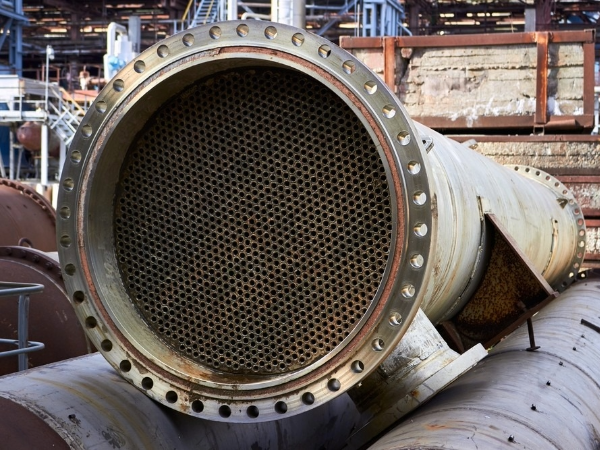
Heat transfer isn't about pipe strength — it's about thermal boundary layer control. For shell-and-tube exchangers, the tube-side Nusselt number Nu = 0.023 × Re^0.8 × Pr^0.4 (Dittus-Boelter) determines film coefficient, not wall thickness. Reynolds regime (Re > 4000 for turbulent) dictates whether you get 500 W/m²·K or 50 W/m²·K. That is why Xenith Steel supplies ASTM A213 TP304/316L heat exchanger tubes with bright annealed finish (Ra ≤0.8μm) — smoother surface reduces fouling factor by 15-20% and sustains turbulent flow at lower velocities. Compared to boiler tubes (pressure-rated per ASME Section I), exchanger tubes prioritize thermal conductivity: 16.2 W/m·K for 304L vs 48 W/m·K for carbon steel SA192. Selection depends on process fluid, design temperature (up to 550°C with stabilized 321H), and chloride concentration (PRE ≥ 24 for 316L in marine environments). Every batch ships with 100% ECT per ASTM A1016 and full MTC 3.1 traceability from Cangzhou mills.
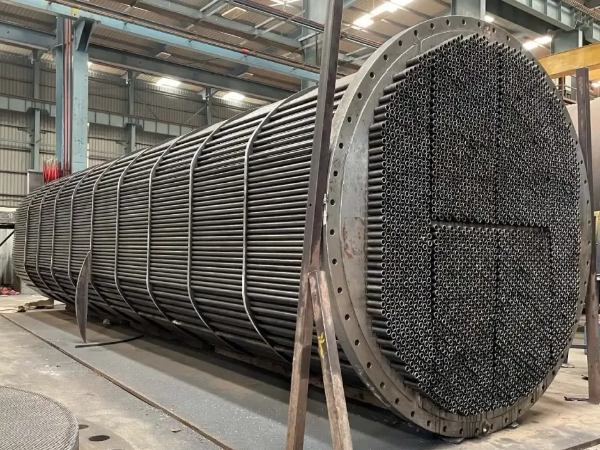
Heat exchanger tube bundle
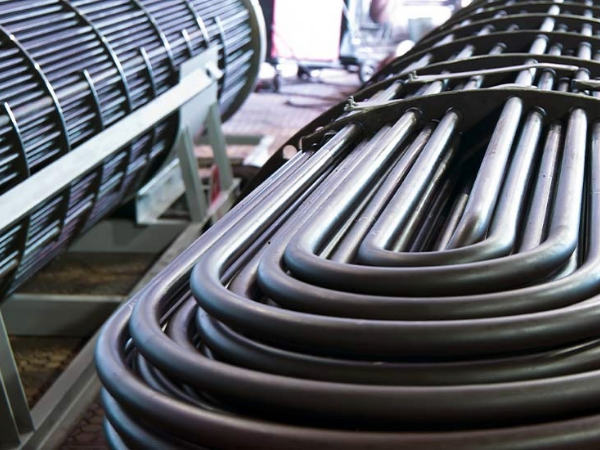
Tube manufacturing process
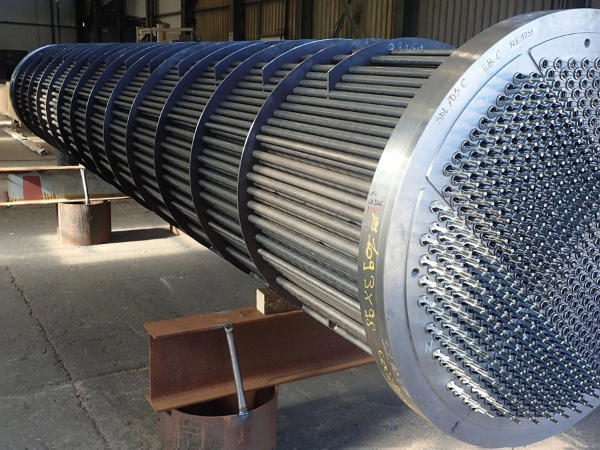
Shell and tube assembly
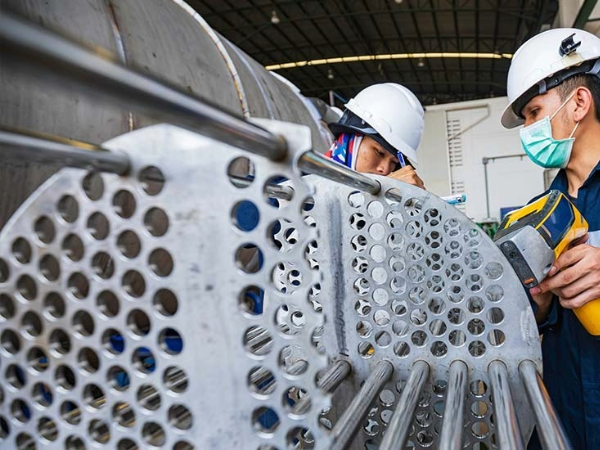
Eddy current testing
Tube packing and export

Heat Exchanger Tubes

Pipe Type:Carbon Steel Heat Exchanger Tube,Alloy Steel Heat Exchanger Tube,Stainless Steel Heat Exchanger Seamless Tube

Outside Diameter:6.00 mm to 101.40 mm

Wall Thickness:0.89 mm to 6.00 mm

Length:Up to 30mtr long

Grades:TP-304, 304L, 304H, 304N, 304LN 316, 316L, 316H, 316Ti, 316N, 316LN, 310, 317, 317L, 321, 321H, 347, 347H;UNS S 31260, 31500, 31803, 32205, 32304, 32750, 32760;TP- 405, 410;A179;A192;T1a;Gr.A-1, Gr.C;Gr.1, Gr. 3, Gr.6;P5, P9, P11, P12, P91;Gr.C2;St35.8, St45.8, 15Mo3, 10CrMo9 10;P195GH, P235GH, 16Mo3, 10CrMo5-5, 13CrMo4-5;09CrsuSb (ND Tube)

Standard:ASTM, ASME, DIN EN, JIS ( JAPAN ), NF ( AFNOR );ASTM A179,ASTM A192,ASTM A209,ASTM A210,ASTM A213,ASTM A334,ASTM A335,ASTM A556,DIN 17175,EN 10216,GB 150.2-2011;


  • Products details
  • Tolerance table
  • Chemical composition
  • Specification


Benefits of Exchanger Tube Bundle

Cost Effective, robust construction
Flexible designs accommodate a broad range of applications
Particularly well-suited for high-pressure applications
Serve both low and high-temperature processes
Efficient / high heat transfer
Designs that allows for easy cleaning, maintenance and repair


Different Types of Heat Exchangers Tube

Direct Contact Heat Exchangers Tubes

Co-current (Parallel) Flow Heat Exchangers Tubes

Recuperators Heat Exchangers Tube

Regenerative Heat Exchangers Tubes


Applications of Heat Exchanger Tubes

Heat Exchanger Tubes are used in Shell and Tube Heat Exchanger with all types of process industries. We offer the market’s widest selection of stainless steel grades and has extensive experience of manufacturing heat exchanger tubes.

Description: Heat exchanger equipment, pipelines and pipeline components

Nuclear Industries
Chemical Industry
Petro-Chemical industry
HVAC (Heating Ventilation Air Conditioning), refrigeration
Food and Beverages
Power Generation


Shell and tube heat exchangers are frequently selected for such applications as:

Process liquid or gas cooling
Process or refrigerant vapor or steam condensing
Process liquid, steam or refrigerant evaporation
Process heat removal and preheating of feed water
Thermal energy conservation efforts, heat recovery
Compressor, turbine and engine cooling, oil and jacket water
Hydraulic and lube oil cooling

  • Process
  • Tests
Accoring to ASTM A213 and ASTM A1016, EN 10216-5:
1. Heat Treatment and Solution Annealing / Bright Annealing
2. Cutting to required length and deburring,
3. Chemical Composition Analysis Test With 100% PMI and One tube from each heat by Direct Reading Spectrometer
4. Visual Testing and Endoscope Testing for Surface Quality
5. 100% Hydrostatic Test and 100% Eddy Current Test
6. Ultrasonic Test subject to the MPS (Material Purchase Specification)
7. Mechanical Tests includes Tension Test, Flattening Test, Flaring Test, Hardness Test
8. Impact Test subject to Standard request
9. Grain Size Test and Intergranular Corrosion Test
10. Ultrasonic measuring of Wall Thickness
  • Packing & Delivery

Stainless Steel Heat Exchanger Tube are surface wash and clean to remove all impurities and stock in the warehouse. Then it is wrapped in thin plastic and also it ends are protected by plastic caps to avoid any damage in transit. Heat Exhanger Shell & tubes is bundled in bubble wrap followed by assorting them in colored plastic bundles. An outer rope is tied to protect the tubing and they are packed in wooden box or container.

  • Tolerance table

Heat Exchanger Tubes Size Chart

Size:1/4″ × 0.035″

Size:3/8″ × 0.035″

Size:1/2″ × 0.035″

Size:5/8″ × 0.035″

Size:3/4″ × 0.035″

Size:1″ × 0.035″

Size:5/16″ × 0.035″

Size:1/4″ × 0.049″

Size:3/8″ × 0.049″

Size:1/2″ × 0.049″

Size:5/8″ × 0.049″

Size:3/4″ × 0.049″

Size:1″ × 0.049″

Size:1/4″ × 0.065″

Size:3/8″ × 0.065″

Size:1/2″ × 0.065″

Size:5/8″ × 0.065″

Size:3/4″ × 0.065″

Size:1″ × 0.065″

Size:1″ × 0.120″

  • Chemical composition

Chemical Composition of Heat Exchanger Pipe


BWG

BWG

BWG

BWG

BWG

BWG

BWG

BWG

BWG


25

22

20

18

16

14

12

10


WT mm

WT mm

WT mm

WT
mm

WT mm

WT mm

WT mm

WT
mm

Outside Diameter

Outside Diameter

0.508

0.71

0.89

1.24

1.65

2.11

2.77

3.40

mm

inch


kg/m

kg/m

kg/m

kg/m

kg/m

kg/m

kg/m

6.35

1/4

0.081

0.109

0.133

0.174

0.212


9.53

3/8

0.126

0.157

0.193

0.257

0.356

0.429


12.7

1/2


0.214

0.263

0.356

0.457

0.612

0.754


15.88

5/8


0.271

0.334

0.455

0.588

0.796

0.995


19.05

3/4


0.327

0.405

0.553

0.729

0.895

1.236


25.4

1


0.44

0.546

0.75

0.981

1.234

1.574

2.05

31.75

1 1/4


0.554

0.688

0.947

1.244

1.574

2.014

2.641

38.1

1 1/2


0.667

0.832

1.144

1.514

1.904

2.454

3.233

44.5

1 3/4


1.342

1.774

2.244

2.894

3.5

50.8

2


1.549

2.034

2.574

3.334

4.03

63.5

2 1/2


1.949

2.554

3.244

4.214

5.13

76.2

3


2.345

3.084

3.914

5.094

6.19

88.9

3 1/2


2.729

3.609

4.584

5.974

7.27

101.6

4


4.134

5.254

6.854

8.35

114.3

4 1/2


4.654

5.924

7.734

9.43

Frequently Asked Questions

1. Why is a heat exchanger tube different from a boiler tube?

Different design basis:

Boiler tube: PRESSURE containment (internal steam pressure)

Heat exchanger: HEAT TRANSFER priority (temperature differential)

That changes everything:

(1) Wall thickness — exchanger tubes thinner for lower thermal resistance

(2) Surface finish — exchanger needs smooth for flow, boiler needs scale-resistant

(3) Thermal cycling — exchanger experiences more expansion/contraction cycles

(4) Finned tubes — exchanger uses fins to increase surface area

Using boiler tube in exchanger = wasted heat. Using exchanger tube in boiler = rupture risk.

2. Why does 316L fail in seawater sometimes?

316L is NOT seawater-proof per ASTM G48:

The pitting corrosion mechanism:

Seawater has ~3.5% chloride (19,000 ppm)

316L: Pitting Resistance Equivalent (PRE = Cr + 3.3Mo + 16N) = 24

Seawater threshold per NACE TM0169: PRE ≥ 40 required for continuous immersion

Options for seawater:

316L + cathodic protection: OK for limited service

254 SMO (PRE=43): Better — meets ASTM A240/A269

Super duplex 2507 (PRE=43): Best — per ASTM A789/A790

Titanium Grade 2: Ultimate — per ASTM B338, PRE > 60

Rule: For continuous seawater service, specify titanium or super duplex per API 5L Annex H.

3. What causes U-bend tube cracks?

U-bend stress is highest at the extrados (outer bend) per ASME Section VIII Div 1:

Failure modes:

(1) Over-bending — tensile strain > 15% at extrados splits the tube per ASME B31.3 Section 304.2.1

(2) Tube surface contamination — oil or carbide during bend causes cracks per AWS D1.6

(3) Tantalum precipitates — in TP347H, causes knife-line attack per ASTM A262 Practice F

Prevention:

Use proper bend radius: R ≥ 3× OD minimum per ASME B31.3 Table 304.2.1

Bend with internal support (mandrel or w/coils)

Stress relieve after bend for critical service per ASME Section VIII UCS-56

4. How does vibration cause heat exchanger failure?

Flow-induced vibration (FIV) per ASME PTC 12.1 Section 5.3:

Natural frequency of tube vs vortex shedding frequency: if they match → resonance → fatigue cracks

Tube natural frequency: f ∝ √(t/D²) per Blevins (1979) Eq 4.8

Vortex shedding: f = St × V / D, where St = Strouhal number (~0.2 for circular cylinders per ASME PTC 12.1 Table 5.3-1)

Critical velocity per API 660 Section 7.4: V_crit = 5 × f_n × D (minimum tube pitch ratio ≥ 1.25)

Prevention:

Add tube supports to increase natural frequency above 30 Hz per TEMA Section RCB-4.2

Use anti-vibration baffles spaced at ≤ 100 × OD per TEMA RCB-4.3

Limit operating velocity at tube entrance to ≤ 60% of V_crit per API 660 Section 7.5

5. Bright annealed vs pickled — which surface for my service?

The corrosion difference per ASTM A1016 Section 12:

Bright annealed (BA):

(1) Free of oxide scale — maximum corrosion resistance per ASTM A262 Practice C

(2) Smooth surface (Ra ≤ 0.8μm) — lower fouling tendency per TEMA Section RCB-3.3

(3) 10-15% higher heat transfer coefficient per ASME PTC 12.1 Table 4.2

Pickled & passivated:

(1) Chromium-depleted layer removed — better passivation per ASTM A967

(2) Slightly rough surface (Ra 1.0-2.0μm) — higher initial fouling

For fouling service: BA; for maximum corrosion resistance: Pickled; for high-purity chemicals: BA

6. What is the tube expanding ratio in tube-sheet joints?

Expanding seals by thinning the tube per TEMA Section RCB-7.3:

Expanding reduction: δ = (pre-OD - post-OD) / pre-OD

Typical expansion: 15-25%

15% = adequate for low pressure (≤ 2MPa per ASME Section VIII Div 1)

20% = normal for most service

>25% = risk of over-stressing tube wall (residual stress limit per TEMA RCB-7.4)

Calculation: Contact pressure = E × δ × (D/t), where E = modulus (200 GPa for SS at 20°C), D = tube OD, t = wall thickness

Higher pressure class per ASME B16.5: Class 150 requires δ ≥ 18%, Class 300 requires δ ≥ 22%

7. What is the difference between 304L and 316L stainless steel for heat exchanger applications?

304L (Low Carbon ≤0.03%) vs 316L (Low Carbon ≤0.03%) per ASTM A240/A269:

(1) Corrosion Resistance: 316L contains 2-3% molybdenum yielding PRE = 24 vs 304L PRE = 19. 316L recommended for coastal/marine environments, chloride-containing media per NACE TM0169. 304L adequate for fresh water, steam, most chemicals.

(2) Temperature: 316L max service temp 400°C (continuous), 304L 300°C per ASME Section II Part D Table 1A. For higher temps, use 321H or 347H (stabilized, max 550°C).

(3) Heat Exchanger Selection: For seawater cooling, use 316L or super-duplex 2507 per API 660. For high-temp steam/thermal oil, use 321H. For general process heat exchange, 304L is cost-effective.

(4) Cost: 316L typically 20-30% higher than 304L due to molybdenum content (2-3% Mo).

PMI testing per ASTM E1476 recommended upon delivery. Both grades meet ASTM A262 Practice E (intergranular corrosion) requirements.

8. What mechanical testing and quality control do you perform on heat exchanger tubes?

100% and sampling tests per ASTM A370, ASTM A1016:

(1) Hydrostatic Test — 100% tested. Test pressure = min(1.5× design pressure, max 17 MPa for austenitic steel per ASME Section VIII UG-99). Hold 10-30 seconds.

(2) Eddy Current Test (ECT) — 100% tested per ASTM A1016/A1040. Sensitivity: 0.5mm diameter FBH equivalent. Ultrasonic alternative for WT > 3mm per ASTM E213.

(3) Tensile Test — per batch. 304 YS ≥ 205 MPa, TS ≥ 515 MPa; 316L YS ≥ 170 MPa, TS ≥ 485 MPa per ASTM A370 Table 4. Elongation ≥ 35% in 50mm.

(4) Flattening Test — per batch. Flattens to 3× WT without cracks per ASTM A1016 Section 17.

(5) Flaring Test — per batch. Tube end expanded 15% without cracks per ASTM A214 Section 8. Essential for U-tube forming.

(6) Hardness Test — per batch. Max 90 HRB (304), 95 HRB (316L) per ASTM A1016 Section 22.

Optional: CVN min 27J at 0°C per API 5L Table 11, intergranular corrosion per ASTM A262 Practice E, grain size per ASTM E112, 100% PMI per ASTM E1476.

9. What surface finishing options do you offer and how do they affect heat exchanger performance?

Surface finish affects heat transfer efficiency, fouling resistance, and cleanability per TEMA Section RCB-3.3:

(1) Bright Annealed (BA) — Argon atmosphere, Ra ≤ 0.8μm. Best corrosion resistance per ASTM A262 Practice C. Recommended for high-purity chemicals, fouling service, sour gas.

(2) Pickled & Passivated — Ra 1.0-2.0μm. Removes mill scale and free iron per ASTM A967. Forms chromium oxide layer (10-15Å). Recommended for general service, water/steam.

(3) Mechanically Polished — Ra ≤ 0.4μm. Improves heat transfer 3-5%. Used for pharmaceutical, food, clean steam per ASME BPE. Requires final passivation.

(4) Sanitary Finish — Ra ≤ 0.8μm, no pits/crevices per 3-A Sanitary Standards. Required for food, dairy, biotech.

Surface finish report with Ra measurement per ASME B46.1 available upon request.

10. How do you ensure leak-free tube-to-tube sheet joints in heat exchanger assembly?

Tube-sheet joints critical for zero-leak performance per TEMA Section RCB-7 and ASME Section VIII Div 1:

(1) Tube End Preparation: Chamfered per ASME Section IX, 30-37° angle, root face 0-1mm. Degreased, no burrs allowed.

(2) Welding: GTAW (TIG) for root pass — argon shielding 99.999%, 15-20 L/min. Filler: ER308L (304), ER316L (316) per AWS A5.9. Welds per AWS D1.6/D17.1, single-sided full penetration.

(3) Post-Weld Treatment: 100% dye penetrant examination (DPE) on root pass per ASTM E165. No undercut, porosity, or cracks acceptable.

(4) Expansion: Roller or hydraulic expander. Expansion ratio 15-20% (1.15-1.25× original ID) per TEMA RCB-7.3. Achieves tube-sheet metallurgical bond, prevents crevice corrosion.

(5) Option: Welded + Expanded (Strengthened Joint) — for high-pressure/thermal cycling per TEMA RCB-7.4. Expansion after welding restores tube wall.

(6) Testing: Optional helium leak test per ASTM E498, sensitivity 1×10⁻⁶ atm·cc/sec. All welders qualified to ASME Section IX.

11. What documentation and certifications do you provide for heat exchanger tube procurement?

Complete documentation package per EN 10204 Type 3.1:

(1) Mill Test Certificate (MTC) 3.1 — Chemical analysis (C, Mn, P, S, Si, Cr, Ni, Mo, Cu, N, Ti, Nb). Heat number full traceability to steel mill.

(2) Mechanical Test Reports — Yield, tensile, elongation actual values per ASTM A370.

(3) 100% ECT Report — Each tube tested, no defects per ASTM A1016.

(4) Hydrostatic Test Certificate — Actual test pressure, hold time, no leakage per ASME Section VIII UG-99.

(5) Dimensional Report — OD (±0.05mm), WT (±0.03mm), length (±1mm), ovality per ASTM A1016.

(6) Surface Finish Report — Ra measurement at 3 points per tube per ASME B46.1.

(7) Heat Treatment Record — Annealing temp, time, atmosphere per ASTM A1016 Section 8.

Third-party inspection: SGS, BV, Lloyd's, TUV, DNV available. Additional certs: NACE MR0175, PED 2014/68/EU, AD 2000 W0. ISO 9001:2015 certified.